
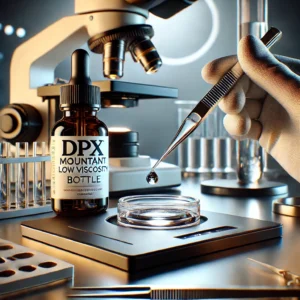
DPX Mountant Low Viscosity is a widely used synthetic resin-based mounting medium designed for histology and microscopy applications. Its low viscosity makes it particularly suitable for use with thin sections and delicate specimens, ensuring a crystal-clear finish for long-term sample preservation.
Features and Benefits
- Low Viscosity: The low viscosity of DPX Mountant allows for easy application and even spreading, reducing the risk of air bubbles. Learn more about the advantages of mounting media from the National Center for Biotechnology Information (NCBI).
- Quick Drying: DPX Mountant dries rapidly, making it a time-efficient choice for laboratories. The Centers for Disease Control and Prevention (CDC) highlights the importance of fast-drying media in diagnostic settings.
- Superior Clarity: Its refractive index closely matches that of glass, ensuring high optical clarity for microscopy. This property is crucial in pathology labs, as emphasized by the National Institutes of Health (NIH).
- Long-Term Stability: DPX Mountant is resistant to fading, maintaining the integrity of stained sections over time. The World Health Organization (WHO) recommends such media for archival purposes.
Applications of DPX Mountant Low Viscosity
- Histological Studies
DPX is extensively used in histology for mounting tissue sections. The University of California, San Francisco (UCSF) uses similar media in its research labs for high-quality tissue preservation. - Diagnostic Pathology
Pathology labs rely on DPX Mountant for analyzing hematoxylin and eosin (H&E)-stained slides, as detailed by the Johns Hopkins University School of Medicine. - Immunohistochemistry (IHC)
The low viscosity of DPX makes it ideal for IHC, where delicate antibody-labeled samples require stable and clear mounting. Learn more from the Mayo Clinic about advancements in IHC techniques. - Educational Microscopy
Universities such as Harvard University recommend DPX Mountant in their microscopy courses due to its ease of use and long-lasting results.

How to Use DPX Mountant
- Prepare the Slide: Ensure the sample is properly dehydrated using ethanol or xylene, as outlined by the Environmental Protection Agency (EPA).
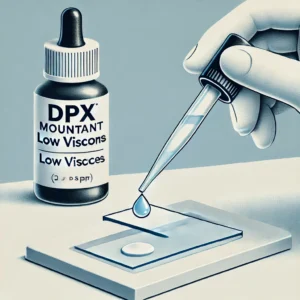
- Apply Mountant: Place a small drop of DPX on the sample and gently lower a coverslip to spread it evenly. Avoid bubbles, as highlighted in protocols from the National Cancer Institute (NCI).
- Drying: Allow the slide to dry in a dust-free environment. The FDA suggests a minimum of 24 hours for complete curing.
Compliance with Standards
DPX Mountant Low Viscosity meets international quality standards, making it a trusted choice for laboratories:
- Good Laboratory Practices (GLP) for consistent results.
- OSHA Guidelines for safe handling of chemical reagents.
- NIST Standards for material consistency.
Research and Case Studies
Numerous research institutions, including Yale University and Stanford University, have incorporated DPX Mountant into their studies. The low viscosity formulation is particularly favored for projects involving delicate biological specimens, as reported in PubMed.
Conclusion
DPX Mountant Low Viscosity remains a critical component in histology and microscopy workflows, offering unparalleled clarity, stability, and ease of use. Its low viscosity formulation enhances the quality of slides, enabling researchers and clinicians to achieve precise results. For further resources, explore links to NIH, CDC, and WHO for comprehensive guidelines on histological sample preparation.