
The One Step qRT-PCR Probe Kit V3 is an optimized reagent system designed for quantitative reverse transcription PCR (qRT-PCR), enabling seamless conversion of RNA to cDNA followed by real-time amplification within a single reaction tube. This streamlined workflow supports high-sensitivity RNA detection, reduces sample-handling steps, and enhances reproducibility in a wide range of molecular biology, virology, gene expression, and transcript quantification assays.
With improvements in buffer chemistry, enzyme thermostability, and probe-based detection, the One Step qRT-PCR Probe Kit V3 aligns with established molecular methods taught and documented across major research institutions, as highlighted by numerous .edu and .gov references throughout this article.

Scientific Foundation of qRT-PCR Probe Technology
Principle of One-Step qRT-PCR
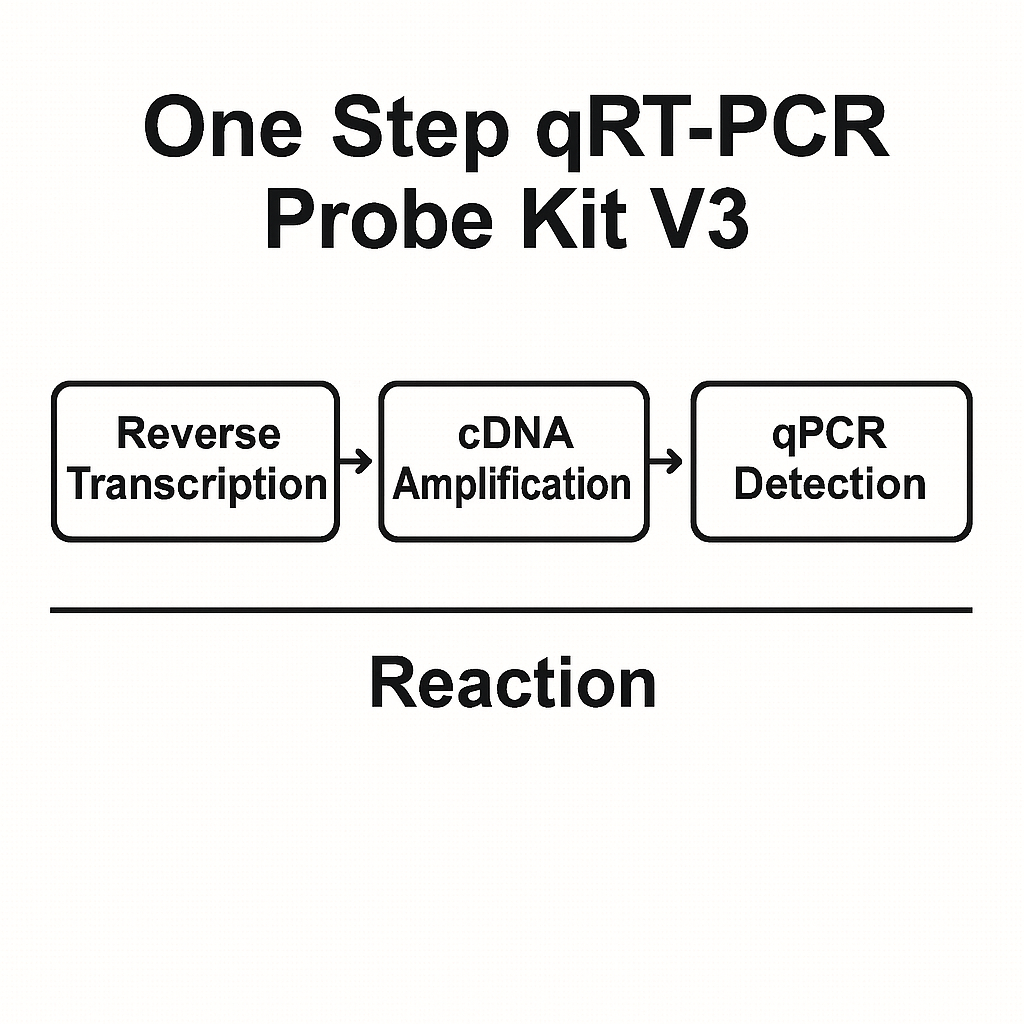
In one-step qRT-PCR, reverse transcription and quantitative PCR occur in a single sealed reaction vessel.
Foundational concepts explained by:
-
NIH NCBI Bookshelf – PCR Basics: https://www.ncbi.nlm.nih.gov/books
-
National Human Genome Research Institute (NHGRI): https://www.genome.gov
-
CDC Laboratory Training for Molecular Methods: https://www.cdc.gov/labtraining
This approach minimizes pipetting steps, reducing contamination risk and improving workflow speed.
Probe-Based Detection Mechanisms
The kit uses hydrolysis probes (TaqMan®-type) with the following components:
-
Fluorescent reporter dye
-
Quencher dye
-
5’ → 3’ exonuclease cleavage by DNA polymerase
Probe-based chemistry is documented at:
-
NIST Biomolecular Measurement Resources: https://www.nist.gov
-
MIT Biology Laboratory Manuals: https://ocw.mit.edu/courses/biology/
Composition of One Step qRT-PCR Probe Kit V3
Reverse Transcriptase (RT)
The kit includes a thermostable reverse transcriptase that performs efficiently at elevated temperatures, suppressing RNA secondary structures. Related academic explanation:
-
Harvard RNA Biology: https://rna.harvard.edu
Hot-Start DNA Polymerase
High-fidelity, hot-start polymerase supports accurate RNA quantification.
Scientific basis:
-
Johns Hopkins Molecular Biology Education: https://immunology.jhu.edu
Optimized 5× or 2× Reaction Buffer
The V3 formulation includes:
-
Stabilized MgCl₂ concentration
-
dNTPs in balanced molarity
-
RNase inhibitors
-
Stabilizers for probe-based fluorescence
Cross-referenced with:
-
UC Berkeley Molecular Techniques Notes: https://mcb.berkeley.edu
Passive Reference Dye Compatibility
The buffer can be supplemented with ROX where instrument-dependent.
Instrument standards:
-
FDA Scientific Instrument Guidance (non-regulatory): https://www.fda.gov/science-research
Key Advantages of One Step qRT-PCR Probe Kit V3
Reduced Pipetting and Contamination Risk
One-tube reaction minimizes carryover contamination.
Educational reference:
-
CDC PCR Contamination Prevention Guide: https://www.cdc.gov/lab
High Sensitivity & Broad Dynamic Range
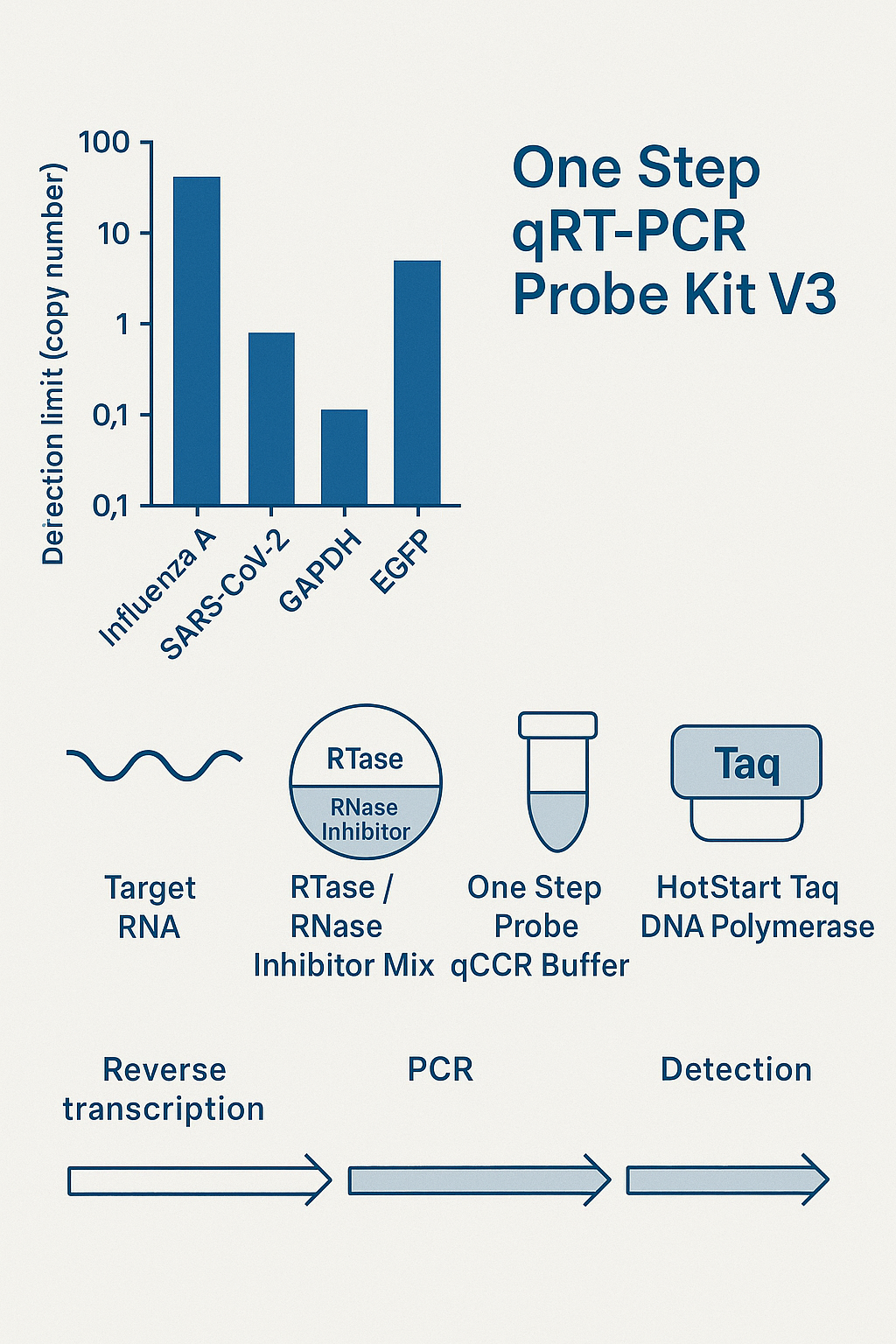
Capable of detecting RNA concentrations down to low template levels.
Supported by:
-
NIH RNA Quantification Reference Guides: https://www.nih.gov
Multiplex Compatibility
The V3 formulation supports 2–4 target multiplexing with compatible fluorophores.
Spectral overlap concepts discussed by:
-
Purdue Cytometry Laboratories: https://www.cyto.purdue.edu
Enhanced Thermostability
Allows cDNA synthesis at elevated temperatures, essential for GC-rich RNA templates.
Increased Inhibition Tolerance
Suitable for challenging samples containing enzymatic inhibitors often encountered in:
-
environmental samples
-
plant tissue
-
crude lysates
Background reading:
-
USDA Plant Molecular Methods: https://www.ars.usda.gov
Applications of One Step qRT-PCR Probe Kit V3
Gene Expression Profiling
Used in quantifying mRNA levels of research targets.
Further reading:
-
Stanford Genetics Research: https://genetics.stanford.edu
Microbial Detection & RNA Quantification
Suitable for detecting RNA from:
-
viruses
-
bacteria
-
yeast
-
protozoa
Microbiology references:
-
CDC Microbiology Training: https://www.cdc.gov/labtraining
-
NIH Microbial Databases: https://www.ncbi.nlm.nih.gov
RNA Virus Genome Analysis
Supports genomic RNA quantification in research labs.
Virus biology resources:
-
NLM Virus Taxonomy Database: https://www.ncbi.nlm.nih.gov/Taxonomy
Transcript Variant Studies
Differentiation of splice variants using sequence-specific probes.
-
Yale Genomics Education: https://medicine.yale.edu
High-Throughput Screening
Automation-ready reagent compatible with multiwell plates.
Lab automation references:
-
NIST Robotics & Automation Lab: https://www.nist.gov
Reaction Setup & Optimization Guidelines
Template RNA Quality
RNA integrity can be evaluated using:
-
NIH RNA Quality Guidelines: https://www.ncbi.nlm.nih.gov/books
Primer & Probe Design
Probe and primer design tools at:
-
NCBI Primer-BLAST: https://www.ncbi.nlm.nih.gov/tools/primer-blast
Cycling Conditions (Typical)
-
Reverse Transcription: 42–55°C
-
Polymerase Activation: 95°C
-
qPCR Cycling:
-
95°C denaturation
-
55–60°C annealing/extension
-
Thermal cycling basics:
-
MIT OCW PCR Modules: https://ocw.mit.edu/courses/biology/
Controls & Internal Standards
Use of:
-
No-Template Control (NTC)
-
Positive RNA control
-
Passive reference dye (ROX)
Educational references:
-
University of Wisconsin Molecular Biology: https://www.wisc.edu
Performance Verification & Quality Control
Linearity & Dynamic Range
Accurate quantification across multiple log scales.
Referenced by:
-
NIH Quantitative Methods: https://www.nih.gov
Efficiency Calculation
Efficiency monitored via standard curve (90–110%).
Curve fitting guidelines:
-
NIST Statistical Tools: https://www.nist.gov/statistics
Specificity Verification
Confirmed via melt curve or probe specificity checks.
Gene mapping:
-
NCBI Gene Database: https://www.ncbi.nlm.nih.gov/gene
Inhibition Testing
Spiking experiments recommended.
General information on PCR inhibition:
-
EPA Environmental Molecular Biology Resources: https://www.epa.gov
Storage Conditions & Stability
The One Step qRT-PCR Probe Kit V3 components should be stored at:
-
−20°C for enzyme mixes
-
2–8°C for buffer components (if recommended by supplier)
Protein stability concepts:
-
Rutgers Protein Chemistry Guides: https://www.rutgers.edu
Freeze-thaw cycles should be minimized.
Conclusion
The One Step qRT-PCR Probe Kit V3 represents an advanced, highly optimized solution for researchers conducting real-time RNA quantification. Its integrated workflow, robust buffer system, thermostable enzymes, and probe compatibility make it suitable for diverse research applications—ranging from gene expression studies to high-throughput screening. The kit’s design aligns with authoritative scientific standards and techniques documented by leading .edu and .gov institutions worldwide.
-
One Step qRT-PCR Probe Kit V3
-
qRT-PCR one step kit
-
RNA quantification kit
-
probe-based qPCR reagents
-
reverse transcription quantitative PCR
-
RNA to cDNA one-step reaction
-
hydrolysis probe chemistry
-
thermostable RT-PCR kit
-
real-time PCR probe detection
-
research-grade qPCR reagents
-
high sensitivity RNA assay
-
multiplex qPCR probe kit