
Molecular and Biological Background of VIPR1
Vasoactive intestinal polypeptide receptor 1 (VIPR1), also known as VPAC1, VIP-R-1 or pituitary adenylate cyclase-activating polypeptide type II receptor, is a class B G protein–coupled receptor (GPCR) for vasoactive intestinal peptide (VIP) and PACAP. According to the NCBI Gene database, VIPR1 is encoded on human chromosome 3p22.1 and belongs to the secretin/GPCR family with a characteristic seven-transmembrane helical topology. INRA Biotechnologie
Key structural and functional features summarized in curated resources like NCBI Gene, UniProt, and Reactome include: INRA Biotechnologie+1
-
Seven transmembrane α-helices (7TM) typical for class B GPCRs.
-
N-terminal extracellular domain responsible for peptide ligand recognition.
-
Coupling to Gs proteins → activation of adenylyl cyclase → increased intracellular cAMP.
-
Expression in multiple tissues including gastrointestinal tract, immune cells, lung, and CNS.
VIPR1 signaling regulates:
-
Smooth muscle relaxation (e.g., intestinal and bronchial smooth muscle).
-
Secretory processes in exocrine glands and gut.
-
Immune modulation, including regulation of T-cell responses and cytokine production.
-
Neurotransmission and neuroprotection, via PACAP/VIP signaling in central and peripheral nervous system.
NCBI expression datasets and RNA-seq projects show VIPR1 expression in multiple human tissues, with relevance to inflammatory disease, cancer biology, and neuro-immune interactions. INRA Biotechnologie
![AffiELISA® Mouse Vasoactive intestinal polypeptide receptor 1 ELISA [ Vipr1]](https://affigen.com/cdn/shop/files/5BAFG-E4345_5D_20AffiELISA_C2_AE_20Cattle_20IFNg_20Kit_20High-Resolution_20Interferon_20Gamma_20ELISA_20Detection_5fda7d90-32e8-4767-aa08-2916faa52a49_535x.png?v=1712861179)
Rationale for Measuring VIPR1 with ELISA
Detecting VIPR1 protein levels in serum, plasma, tissue lysates, or cell culture supernatants is valuable for:
-
Studying VIP–PACAP–VPAC1 axis in gastrointestinal and pulmonary physiology.
-
Exploring VIPR1 as a biomarker for inflammation, autoimmune disease, and tumor biology.
-
Evaluating drug candidates targeting GPCR signaling or immunomodulatory pathways.
Commercial research ELISA kits for VIPR1 (human, mouse, rat) are widely available and use sandwich ELISA principles with high sensitivity in the sub-ng/mL range. AffiGEN+4Fn-Test+4Assay Genie+4
General Principle of VIPR1 ELISA (Sandwich Format)
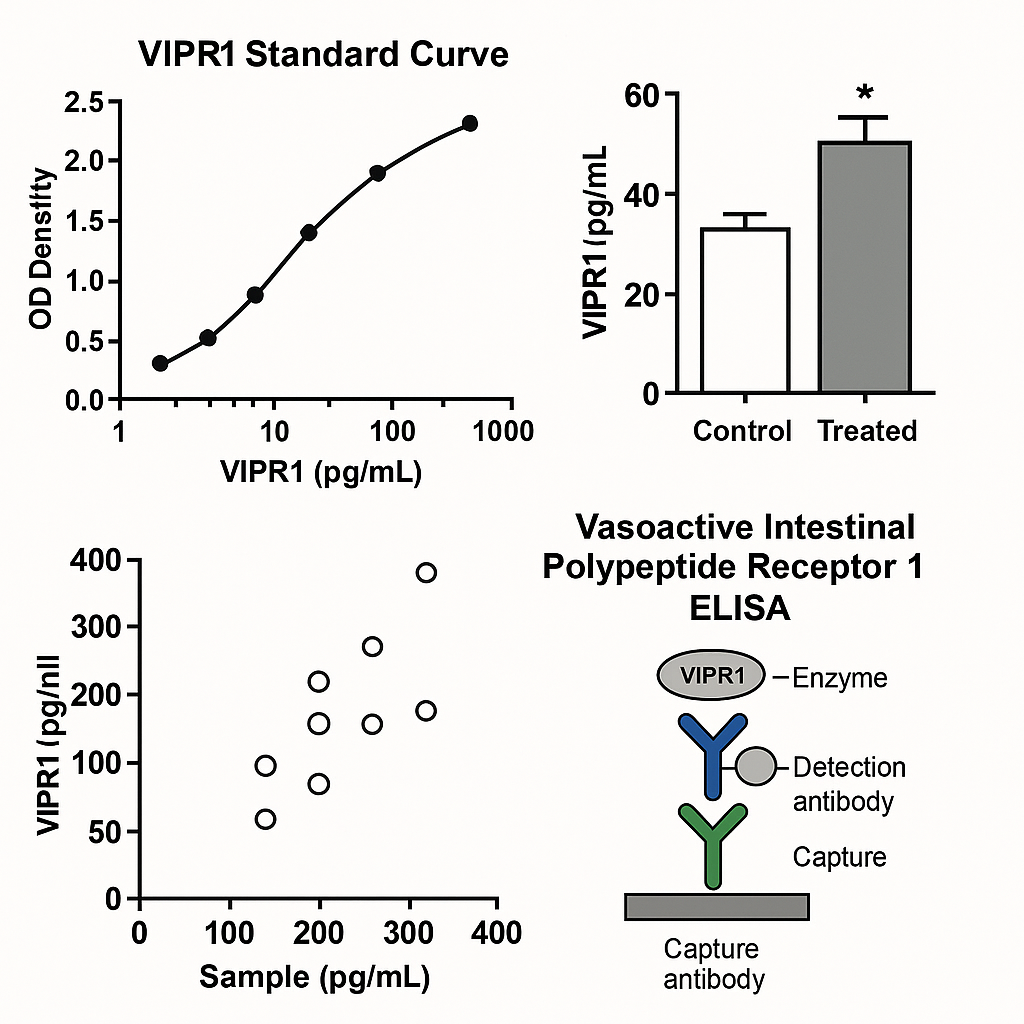
Typical Vasoactive Intestinal Polypeptide Receptor 1 ELISA kits are quantitative sandwich ELISAs using a capture antibody pre-coated on a 96-well microplate:
-
Capture phase
-
Microplate wells are pre-coated with a VIPR1-specific antibody. Fn-Test+1
-
Standards and appropriately diluted samples (serum, plasma, cell culture supernatant, tissue or cell lysate) are added.
-
-
Binding and washing
-
VIPR1 in samples binds to the immobilized capture antibody.
-
Wells are washed to remove unbound components.
-
-
Detection antibody
-
A biotinylated detection antibody against a distinct epitope of VIPR1 is added, forming an antibody-antigen-antibody “sandwich”. Fn-Test+1
-
-
Enzyme conjugate
-
HRP–streptavidin (or HRP-conjugated secondary antibody) is added to bind biotinylated detection antibody.
-
-
Substrate reaction
-
TMB (3,3′,5,5′-tetramethylbenzidine) substrate is added; HRP catalyzes conversion to a blue product.
-
Reaction is stopped by an acidic stop solution, yielding a yellow end-product.
-
-
Optical density measurement
-
Absorbance is read at 450 nm (with a 620–630 nm reference, depending on kit). G-Biosciences+3Fn-Test+3Assay Genie+3
-
-
Quantification
-
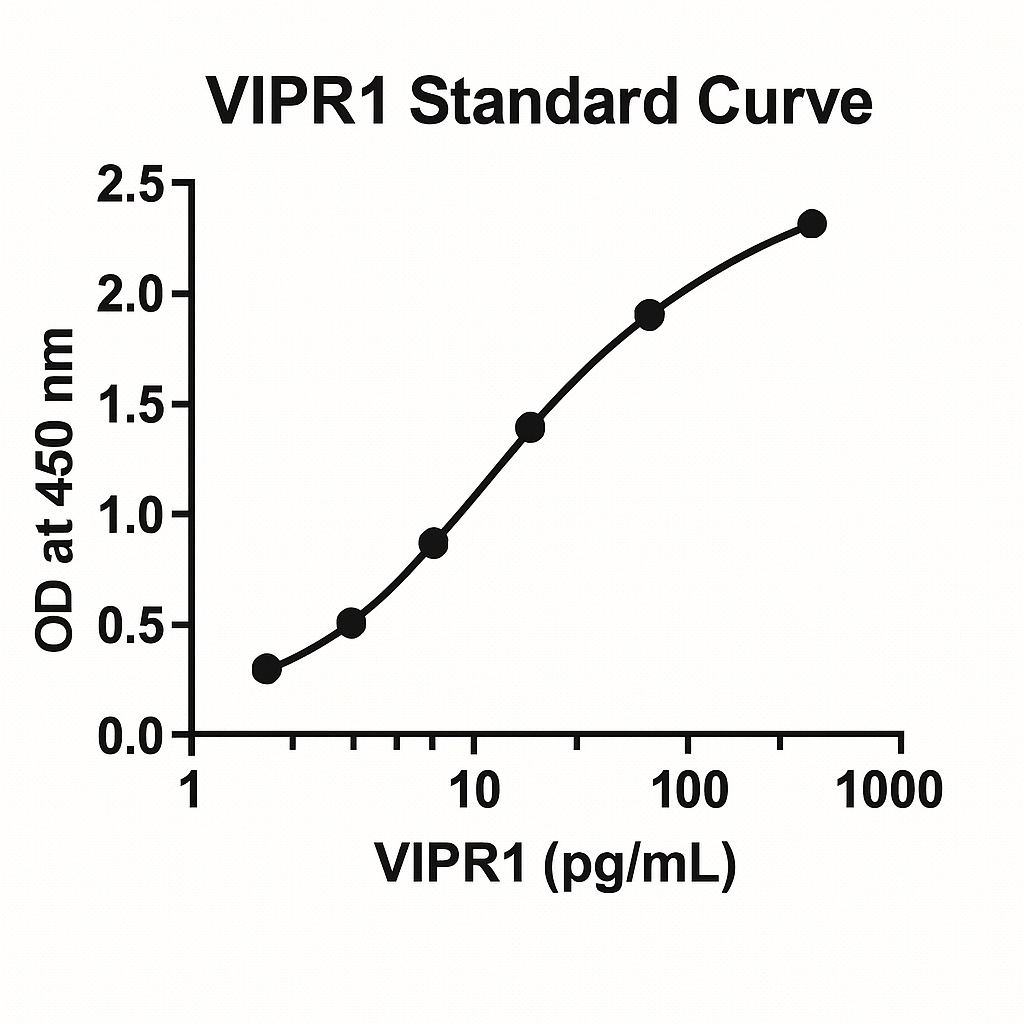
A standard curve is generated from known VIPR1 standards (typical range ~0.156–10 ng/mL, with sensitivity ~0.094 ng/mL for many human kits). Fn-Test+2Assay Genie+2
-
Sample concentrations are interpolated from the standard curve and corrected for dilution factors.
-
Assay Characteristics and Performance Parameters
From multiple manufacturers’ technical data: AffiGEN+4Fn-Test+4Assay Genie+4
-
Format: Quantitative sandwich ELISA.
-
Sample types: Serum, plasma, cell culture supernatant, tissue and cell lysates, and other biological fluids (depending on kit).
-
Range: Frequently 0.156–10 ng/mL for human VIPR1.
-
Sensitivity: Typically around 0.094 ng/mL for human kits.
-
Specificity: High specificity for VIPR1 with no significant cross-reactivity to related analogs when validated.
-
Assay time: 4 hours for many standardized kits; some provide 1–5 h flexible protocols.
-
Species: Human, mouse, rat VIPR1 ELISA versions; some vendors brand rodent kits under AffiELISA® or similar lines.
Intra- and inter-assay coefficients of variation (CVs) are usually reported <10–15%, in line with general recommendations for quantitative immunoassays.
Sample Preparation and Pre-Analytical Considerations
Although each kit has its own IFU, common pre-analytical principles apply:
-
Serum / plasma
-
Collect using standard phlebotomy procedures; avoid hemolysis.
-
Use anticoagulants recommended by kit (e.g., EDTA, heparin, or citrate).
-
Centrifuge to remove cells and debris; store aliquots at −20 °C or −80 °C to avoid repeated freeze–thaw.
-
-
Cell culture supernatant
-
Collect supernatant after appropriate incubation; centrifuge to clear, then store frozen.
-
-
Tissue and cell lysates
-
Homogenize in lysis buffer compatible with ELISA (usually non-denaturing, without high detergents or interfering chemicals).
-
Normalize protein concentrations when comparing different samples.
-
Manufacturers typically indicate maximum storage time and recommended storage temperature (often 2–8 °C for unopened kits and frozen aliquots for processed samples). G-Biosciences+4anticorps-enligne.fr+4Fn-Test+4
For general immunoassay pre-analytics, many lab-medicine courses (CLIA/NCCLS/CLSI-aligned) taught via academic institutions and public resources like CDC LabQuality are referenced by labs to maintain consistent sample integrity. INRA Biotechnologie
Standard Curve Construction and Data Analysis
Standard Preparation
-
VIPR1 standards are reconstituted and serially diluted (e.g., two-fold) to generate a set of calibrators within the reported range (0.156–10 ng/mL or kit-specific). Fn-Test+1
-
A zero standard (assay diluent only) defines background.
Curve Fitting
-
Most ELISA data analysis uses 4-parameter logistic (4PL) or 5-parameter logistic (5PL) regression to model OD vs. concentration.
-
Goodness-of-fit is assessed via R² and residual plots; outlier points may indicate pipetting errors or improper reconstitution.
Internal Quality Control
-
Positive control and QC samples (low, medium, high VIPR1) are run with each plate.
-
Levey–Jennings charts are used to monitor QC sample performance and detect trends, shifts, or random error.
These principles align with general ELISA and immunoassay QC guidance in clinical chemistry and immunology training and CLSI documents.
Analytical Specificity, Cross-Reactivity, and Interference
Manufacturer-validated VIPR1 ELISA kits typically report: G-Biosciences+3Fn-Test+3Assay Genie+3
-
High specificity for VIPR1 with negligible cross-reactivity to closely related receptors (e.g., VPAC2) or non-related proteins.
-
Testing against common serum matrix components and additives to verify absence of significant interference at physiological concentrations.
Potential interfering factors that may require local verification:
-
High lipid content (lipemia).
-
Hemolysis (free hemoglobin).
-
Hyperbilirubinemia.
-
Extreme pH or detergents in lysates.
Laboratories may perform local interference studies using CLSI EP07-style designs to document acceptable interference thresholds.
VIPR1 Biology and Research Applications
VIPR1 in Immunology and Inflammation
VIPR1 is expressed on T cells, monocytes, and other immune cells; NCBI Gene cites publications demonstrating modulation of immune function and altered VIPR1 expression in inflammatory models. INRA Biotechnologie
Applications of VIPR1 ELISA in immunology research:
-
Measuring changes in VIPR1 protein levels in PBMC lysates in response to cytokine stimulation or LPS.
-
Characterizing VIPR1 modulation in autoimmune and inflammatory diseases.
VIPR1 in Gastrointestinal and Pulmonary Physiology
VIPR1 mediates VIP-dependent smooth muscle relaxation and regulation of intestinal and bronchial tone. Reactome pathway annotations associate VIPR1 with cAMP signaling cascades downstream of VIP and PACAP. stjohnslabs.com+1
VIPR1 ELISA allows:
-
Correlative studies between VIPR1 expression and gastrointestinal motility disorders.
-
Evaluation of VIPR1 changes in airway tissues in asthma, COPD or experimental bronchoconstriction models.
VIPR1 in Oncology
NCBI Gene bibliography lists down-regulation or deletion of VIPR1 in certain cancers (e.g., lung adenocarcinoma) and interactions with viral proteins such as HIV-1 gp120 and Tat, which can modulate VIPR1 expression. INRA Biotechnologie
VIPR1 ELISA may support:
-
Comparative VIPR1 quantification in tumor versus normal tissue lysates.
-
Functional studies on how VIPR1 protein levels correlate with proliferation, invasion, or response to therapy.
Example Kit Types and Species Reactivity
Multiple vendors provide human, mouse, and rat VIPR1 ELISA kits with similar designs and performance claims: AffiGEN+4Fn-Test+4Assay Genie+4
-
Human VIPR1 ELISA Kit
-
Sandwich ELISA, 96-well format.
-
Range: ~0.156–10 ng/mL, sensitivity ~0.094 ng/mL.
-
Sample types: serum, plasma, cell culture supernatant, cell/tissue lysates.
-
-
Mouse VIPR1 ELISA Kit
-
Quantitative sandwich ELISA.
-
Sensitivity often in pg/mL range (e.g., 7.8 pg/mL).
-
Sample types similar to human kit; research area frequently indicated as neuroscience. AFG Scientific
-
-
Rat VIPR1 ELISA Kit (e.g., AffiELISA® Rat VIPR1 ELISA)
-
96-test format, designed for rat samples.
-
Used in cardiovascular, GI, neurobiology and endocrine studies. AffiGEN
-
Quality Control, Reproducibility, and Regulatory Context
Although VIPR1 ELISA kits are sold for research use only (RUO), many laboratories adopt clinical-style QC frameworks:
-
Routine inclusion of positive and negative controls on every plate.
-
Replicate measurements (duplicates or triplicates) per sample.
-
Documentation of inter-operator and inter-lot variability.
-
Long-term QC tracking and calibration verification in line with general CLIA and ISO 15189 quality systems for immunoassays. INRA Biotechnologie
Regulatory agencies such as the FDA and public resources from CDC and academic medical centers provide general guidelines on the validation of immunoassays, which research laboratories can adapt to fit RUO ELISA workflows.
Summary
Vasoactive Intestinal Polypeptide Receptor 1 (VIPR1) ELISA Kit
This quantitative sandwich ELISA is designed for the precise measurement of VIPR1 (VPAC1) levels in serum, plasma, cell culture supernatant, and tissue lysates. The assay uses a high-affinity capture antibody pre-coated on a 96-well plate, a biotinylated detection antibody, and an HRP/TMB colorimetric read-out at 450 nm. Typical analytical characteristics include a dynamic range of 0.156–10 ng/mL and sensitivity around 0.094 ng/mL, with excellent specificity for VIPR1 and minimal cross-reactivity with related proteins. Vasoactive intestinal polypeptide receptor 1 is a GPCR involved in cAMP-mediated signaling, immune modulation, gastrointestinal motility, and neuro-immune communication, making VIPR1 ELISA a powerful tool for neuroscience, immunology, cancer, and metabolism research. For Research Use Only. Not for diagnostic procedures.