
Introduction: Molecular Detection of Mpox Virus and the Critical Role of Quality Control
Monkeypox (Mpox), caused by the Monkeypox virus (MPXV), is an Orthopoxvirus whose detection relies primarily on real-time Polymerase Chain Reaction (qPCR) and digital PCR (dPCR) platforms. Public-health agencies such as the CDC (https://www.cdc.gov/poxvirus/mpox/index.html), WHO (https://www.who.int), and ECDC (https://www.ecdc.europa.eu/en/monkeypox) emphasize that PCR remains the most reliable method due to its stringent specificity, rapid detection capability, and ability to differentiate clades.
Given the sensitivity of qPCR, rigorous quality control (QC) is indispensable for mitigating false-positives, preventing false-negatives, ensuring reproducibility, and meeting accreditation standards such as ISO 15189 and CLIA (https://wwwn.cdc.gov/clia/).
Academic laboratories such as Harvard University (https://learn.harvard.edu), Stanford University (https://med.stanford.edu), and Johns Hopkins (https://publichealth.jhu.edu) provide foundational principles on molecular diagnostics that reinforce the need for strict QC in viral PCR workflows.
Molecular Targets in Mpox PCR Assays
Mpox PCR assays often target conserved genomic regions such as:
-
G2R gene
-
F3L gene
-
B6R gene
-
B7R gene
-
TNF receptor gene
-
Orthopoxvirus generic genes (E9L DNA polymerase, hemagglutinin HA gene)
Research published in NCBI/PubMed (https://www.ncbi.nlm.nih.gov) shows that multi-target PCR assays reduce the risk of false-negatives caused by genomic variability.
WHO’s Mpox laboratory guidance (https://www.who.int/publications/i/item/WHO-MPX-Laboratory-2024.1) also recommends dual-target or multiplex systems to compensate for sequence drift.
Pre-Analytical Quality Control: Sample Handling and Biosafety
Sample Collection
According to the CDC diagnostic testing page (https://www.cdc.gov/monkeypox/hcp/diagnosis-testing/index.html), validated sample types include:
-
Lesion swabs (vesicle fluid, pustules, crust material)
-
Oropharyngeal swabs (secondary only)
-
Tissue biopsies (research settings)
-
Environmental samples
Sample QC considerations:
-
Use of synthetic-tipped, non-wooden swabs
-
Avoiding PCR inhibitors (hemoglobin, urea, topical substances)
-
Maintaining cold chain storage at 2–8°C
Guidelines from University of California, San Francisco (UCSF) (https://meded.ucsf.edu) and University of Michigan (https://medicine.umich.edu) stress that pre-analytical variables contribute to 70% of laboratory errors, making them a primary QC target.
Biosafety Protocols
Based on the WHO Laboratory Biosafety Manual (https://www.who.int/teams/health-product-policy-and-standards/standards-and-specifications/laboratory-biosafety), Mpox workflows require:
-
BSL-2 laboratory infrastructure
-
Class II biosafety cabinets
-
UN3373 packaging for transport
-
Full PPE including N95/FFP2 masks
Academic biosafety courses at NIH (https://www.nih.gov), CDC (https://www.cdc.gov/labquality), and University of Washington (https://depts.washington.edu) reinforce these practices.
Nucleic Acid Extraction Quality Control
Extraction QC validates the efficiency, purity, and integrity of MPXV DNA before amplification.
Internal Extraction Controls
-
Human RNase P gene
-
Exogenous bacteriophage DNA (e.g., MS2 phage)
-
Armored DNA constructs
These ensure that extraction and amplification occurred without inhibition.
CDC NAAT QC guidance (https://www.cdc.gov/labquality) stresses their necessity for every molecular assay.
Extraction Efficiency Indicators
Quantitative QC metrics include:
-
Expected RNase P Ct threshold
-
Absence of abnormal amplification curves
-
Correlation between input sample volume and yield
Extraction inhibition patterns are described in molecular biology textbooks from MIT OpenCourseWare (https://ocw.mit.edu) and UC Berkeley MCB (https://mcb.berkeley.edu).
Analytical QC: PCR Run Controls
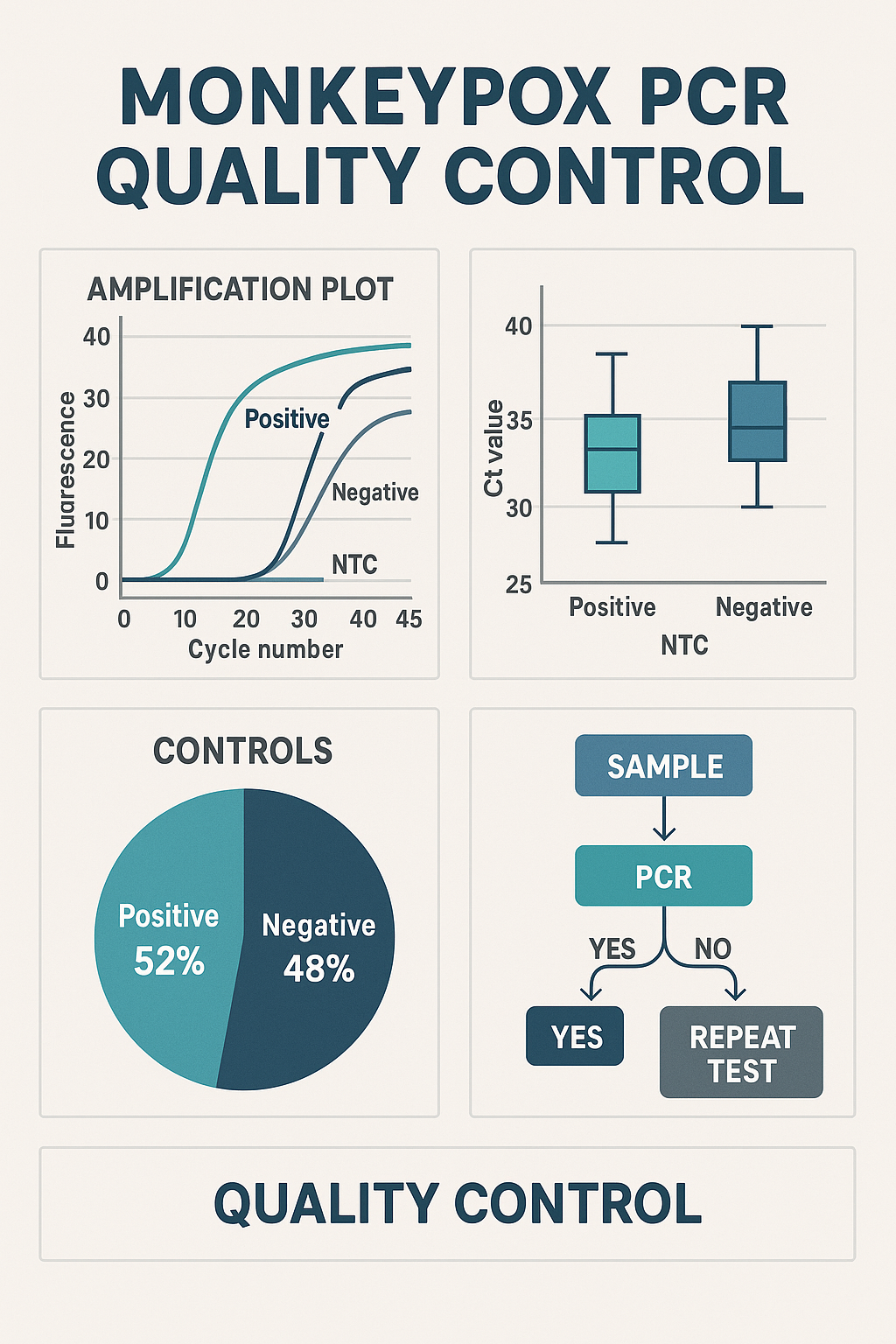
External Positive Control (EPC)
A purified or synthetic MPXV DNA control used to evaluate:
-
Efficiency (slope between −3.1 and −3.6)
-
Standard curve linearity (R² ≥ 0.98)
-
Ct consistency across runs
Negative Template Control (NTC)
Ensures absence of contamination in:
-
Reagents
-
Pipettes
-
Thermal cyclers
-
Workflow environment
Negative Extraction Control (NEC)
Detects carryover contamination and aerosolized amplicons.
CDC and FDA Mpox device pages (https://www.fda.gov/medical-devices/emergency-situations-medical-devices/monkeypox-mpox-and-medical-devices) detail the importance of external QC materials.
PCR Amplification QC Metrics
Cycle Threshold (Ct) Monitoring
Ct drift is one of the most important performance indicators:
-
Increased Ct → low template, reagent degradation, inhibition
-
Decreased Ct → contamination, pipetting error
Laboratories use Levey–Jennings charts for longitudinal tracking, as described in pathology training from Columbia University (https://www.columbia.edu) and UNC School of Medicine (https://www.med.unc.edu).
Amplification Curve Analysis
QC includes verifying:
-
Sigmoidal curve kinetics
-
Baseline fluorescence stability
-
Lack of non-specific amplification
Resources from NIH NCBI Bookshelf (https://www.ncbi.nlm.nih.gov/books/) describe common amplification artifacts and curve anomalies.
Validation and Verification Processes
Validation Parameters
-
Limit of Detection (LoD)
Determined using serial dilution (10–0.1 copies/µL).
Methodologies detailed in CLSI M52 and university molecular pathology courses (e.g., Yale: https://medicine.yale.edu). -
Precision and Repeatability
20 replicates × 3 days × 2 operators. -
Inclusivity and Exclusivity Testing
Panels should include:-
Variants from Clade I and Clade II
-
Orthopoxviruses (Vaccinia, Cowpox, Camelpox)
-
Viral respiratory targets (Influenza, RSV, Adenovirus, etc.)
-
WHO and PAHO Mpox guidelines (https://www.paho.org/en) include inclusivity testing frameworks.
Lot-to-Lot Verification
Using:
-
Old vs new reagent lots
-
Comparison of Ct values
-
Acceptable deviation <1 Ct
FDA molecular device validation guidance (https://www.fda.gov) outlines equivalence testing principles.
External Quality Assessment (EQA) and Proficiency Testing (PT)
EQA/PT programs provide blinded panels containing serial concentrations of MPXV DNA.
Pan-regional EQA programs coordinated by:
-
PAHO (https://www.paho.org/en)
-
CDC (https://www.cdc.gov)
-
UK Health Security Agency (UKHSA) (https://www.gov.uk/government/collections/monkeypox-guidance)
EQA assesses:
-
False-positive rate
-
False-negative rate
-
Inter-laboratory variability
-
Target dropout patterns
-
Cross-reactivity with Orthopoxviruses
Studies published in NCBI (https://www.ncbi.nlm.nih.gov/pmc/) show that EQA participation significantly improves long-term accuracy.
Digital PCR (dPCR) QC for Mpox
Emerging reference laboratories employ dPCR for quantification of MPXV DNA.
Advantages include:
-
Absolute quantification (no standard curves)
-
Lower susceptibility to inhibitors
-
Higher sensitivity for low-copy detection
University research at Caltech (https://www.caltech.edu) and Oxford University (https://www.ox.ac.uk) supports the adoption of dPCR for viral quality material quantification.
Data Interpretation and Reporting Quality Control
QC requires rigid interpretation rules based on:
-
Ct cutoffs
-
Dual-target concordance
-
Internal control performance
-
Curve morphology
-
Inhibition indicators
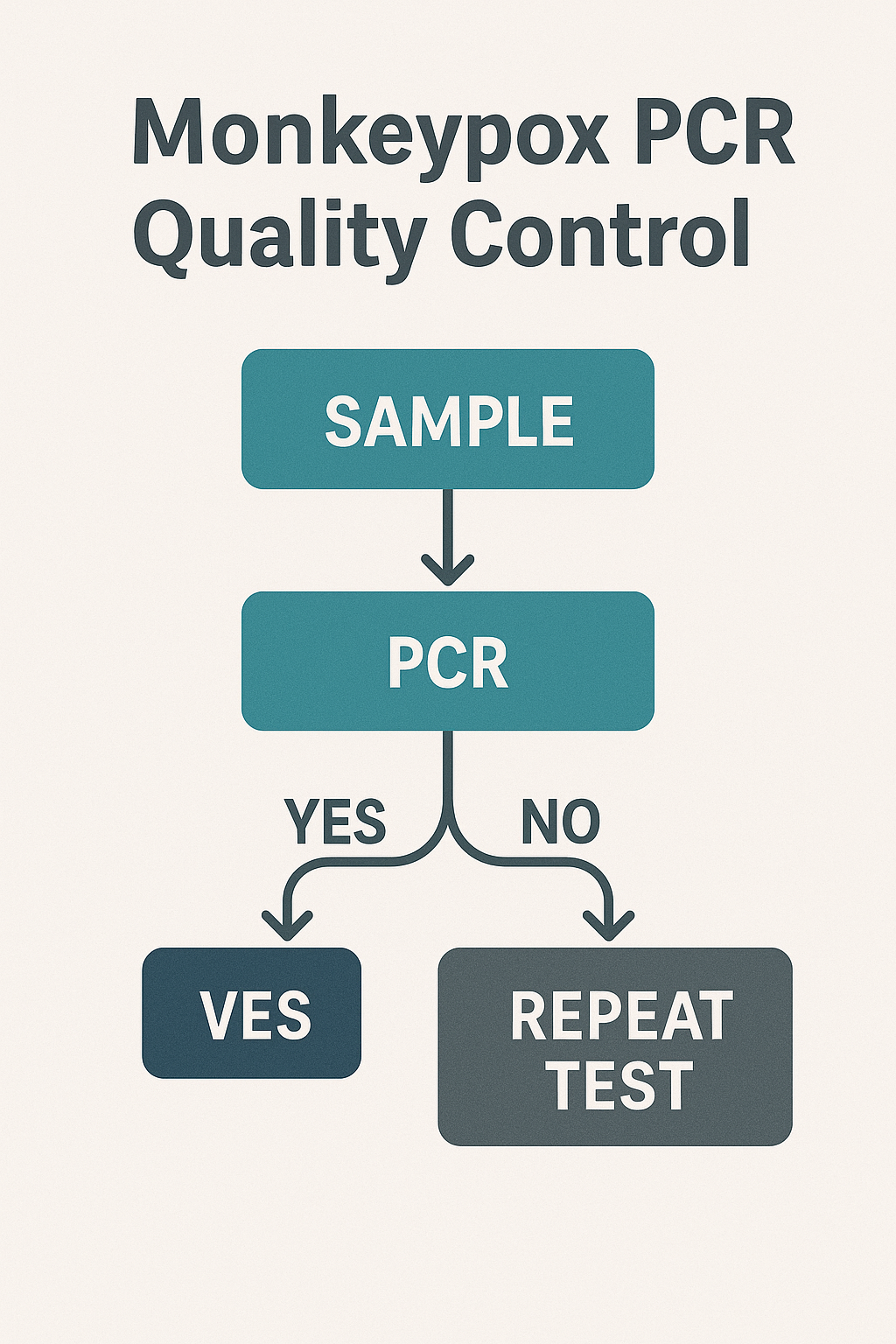
If results do not meet criteria:
-
Repeat extraction
-
Re-amplify sample
-
Evaluate reagent integrity
-
Perform contamination audit
Academic sources such as Dartmouth Geisel School of Medicine (https://geiselmed.dartmouth.edu) and Mayo Clinic Laboratories Education (https://www.mayoclinic.org) offer reference frameworks for NAAT interpretation QC.
Environmental QC and Contamination Prevention
Labs must implement:
-
Separate pre-PCR and post-PCR rooms
-
UV-C workflows
-
Regular swab testing (work surfaces & instruments)
-
Unidirectional workflow
-
Aerosol-resistant filter tips
These recommendations are consistent with high-containment guidelines from NIH Office of Science Policy (https://osp.od.nih.gov) and CDC Biosafety (https://www.cdc.gov/labs).
Long-Term QC Trending, Instrument Calibration, and Maintenance
PCR instrumentation QC includes:
-
Optical calibration
-
Dye spectral calibration
-
Block uniformity testing
-
Ramp rate verification
-
Preventative maintenance logs
Recommendations appear in molecular diagnostics training from University of Minnesota (https://med.umn.edu) and University of Florida (https://ufl.edu).
Integration of QC into Laboratory Information Management Systems (LIMS)
Modern laboratories integrate Mpox PCR QC into LIMS systems to track:
-
Ct trends
-
Lot numbers
-
Operator ID
-
Environmental QC logs
-
Control materials’ expiration
-
EQA/PT performance reports
Public-health informatics principles are taught by CDC’s Public Health Informatics program (https://www.cdc.gov/phin).
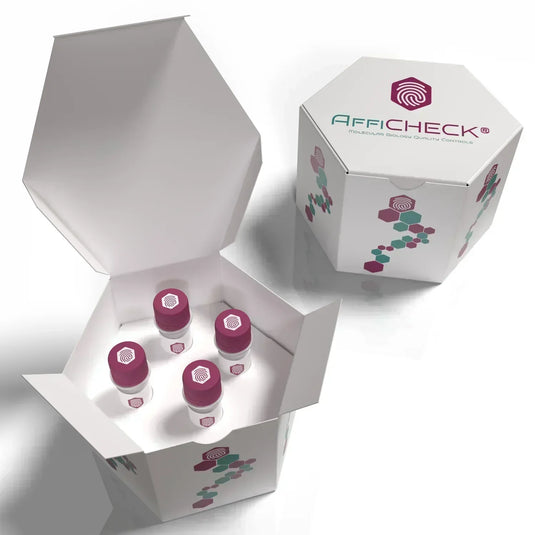
The Monkeypox (Mpox) PCR Quality Control system provides high-stability positive controls, negative controls, extraction controls, and amplification controls engineered for real-time PCR and digital PCR detection of Mpox virus DNA. Designed for research laboratories, these QC materials support robust analytical sensitivity, high reproducibility, contamination monitoring, and full compliance with ISO 15189, CLIA, CDC, and WHO quality frameworks. Suitable for Orthopoxvirus molecular workflows using G2R/F3L/B6R gene targets. For Research Use Only (RUO).