
Introduction
In clinical and environmental testing, the comet assay has become a key method for measuring DNA integrity at the single-cell level. Its relevance spans across genetic toxicology, population biomonitoring, environmental health, and preclinical evaluation of chemical agents. First described in the 1980s, the method has evolved into a highly adaptable platform, particularly with the availability of diagnostic-grade kits. These kits enable scientists to perform reproducible, sensitive, and high-throughput DNA damage studies.
The technique’s sensitivity to detect single-strand breaks, alkali-labile sites, and crosslinking has allowed researchers to investigate subtle genetic responses to various physical and chemical exposures. This article provides a detailed comparison of widely used comet assay kits, with a focus on their use in both peripheral blood and buccal cell applications. All discussed applications align with accepted research standards and are supported by data from public scientific resources and institutions.
The Role of Comet Assay in Modern Research
The comet assay—or single-cell gel electrophoresis (SCGE)—has become a universal platform for DNA strand break analysis. It’s favored due to its simplicity, low cost, minimal cell number requirement, and ability to provide data on a per-cell basis. For a primer on comet assay principles, visit NCBI.
Its use is supported by many peer-reviewed studies archived in public repositories such as:
These platforms show its diverse application in biological damage detection following exposure to radiation, metals, nanomaterials, endocrine disruptors, and dietary agents.
Alkaline vs Neutral Comet Assay
The comet assay is primarily performed under two electrophoresis conditions:
-
Alkaline: Detects both single- and double-strand breaks as well as alkali-labile sites.
-
Neutral: Detects only double-strand breaks.
The alkaline version is more sensitive and is commonly used in human biomonitoring studies. For more information, refer to technical guidelines published by OECD Test Guidelines No. 489.
Peripheral Blood vs Buccal Cells in Comet Assay
Peripheral Blood Lymphocytes (PBLs)
Peripheral blood lymphocytes are the most commonly used cells for comet assay studies in clinical diagnostics and genotoxicity testing. They are accessible through routine phlebotomy and provide a uniform population for scoring DNA damage. Studies hosted on PubChem and NIH RePORTER show that peripheral blood analysis is used in chronic exposure monitoring, including air pollution and occupational settings.
Lymphocyte DNA integrity has been shown to reflect systemic damage, making it suitable for studies in:
-
Occupational health
-
Nutritional genotoxicity
-
Drug development research
Buccal Epithelial Cells
Buccal cells offer a convenient, non-invasive alternative for DNA damage evaluation, especially in studies involving children, elderly participants, or large-scale community surveillance. Their collection involves minimal discomfort and does not require trained medical staff.
However, buccal cells may present variability due to:
-
Presence of bacteria
-
Varying desquamation rates
-
Salivary contamination
The CDC’s National Health and Nutrition Examination Survey (NHANES) includes buccal sampling in genomic and epigenomic studies. Moreover, EPA’s Human Health Research Program highlights their utility in understanding population-level genomic responses to environmental exposures.
Comparative Performance of Diagnostic-Grade Comet Assay Kits
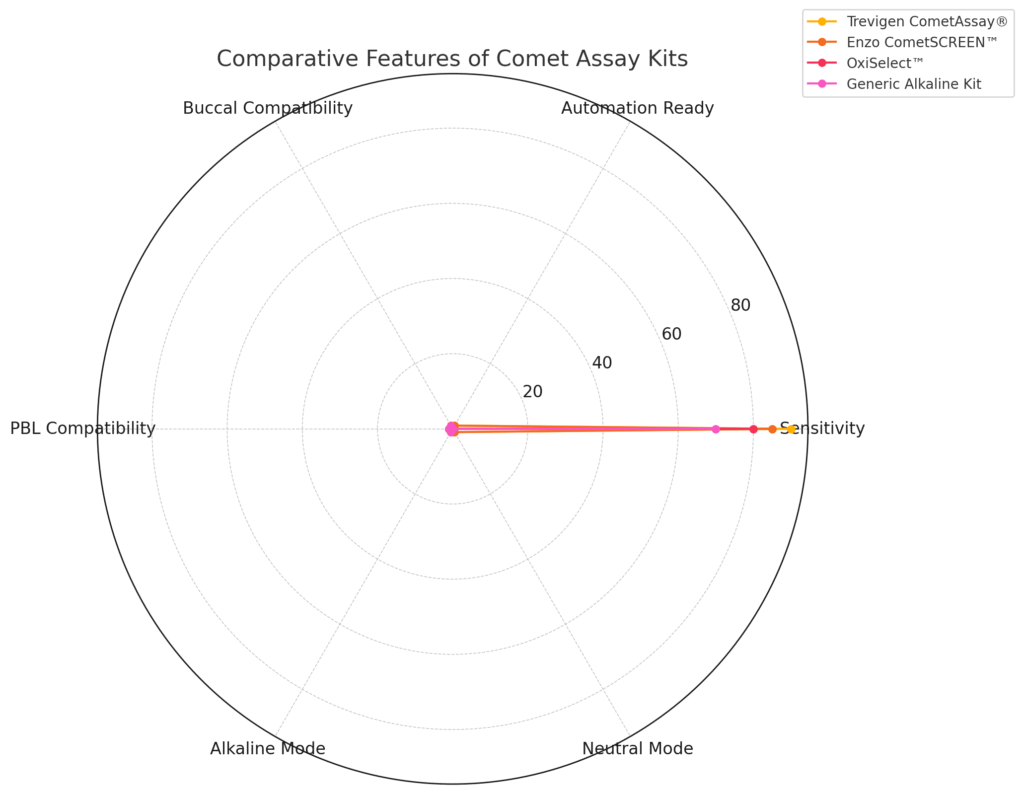
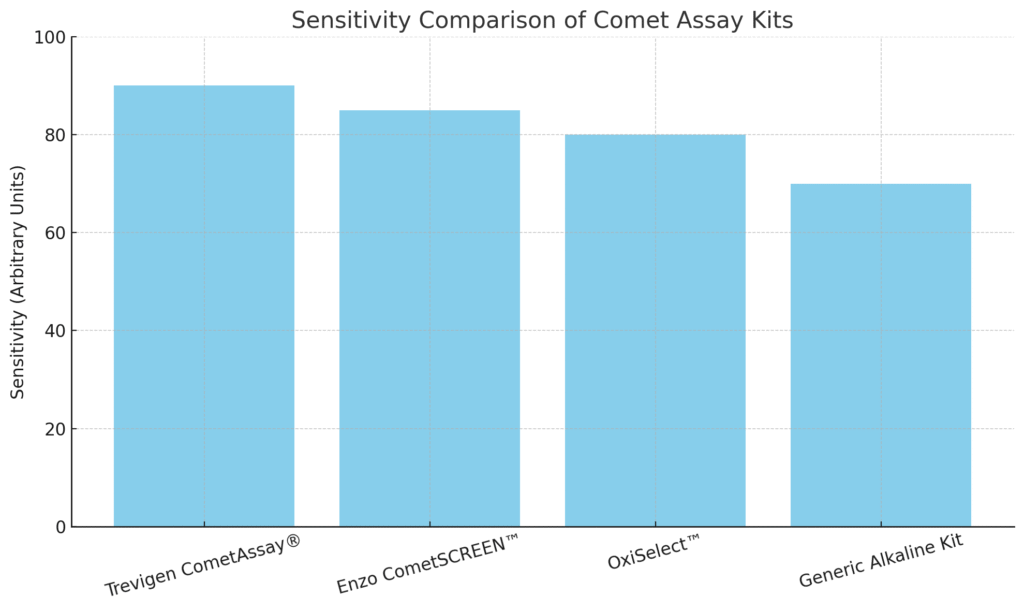
Numerous comet assay kits exist, each with unique strengths. The following kits are widely referenced in clinical research and biomonitoring:
1. Trevigen CometAssay® Kit
-
Gel matrix: Low-melting-point agarose
-
Format: Slide-based (pre-coated or uncoated)
-
Scoring: Manual or compatible with commercial imaging software
-
Sample types: Blood, cultured cells, buccal cells
-
DNA damage detection: Both alkaline and neutral
Publications on PubMed Central and datasets from Gene Expression Omnibus (GEO) demonstrate its wide adoption in biomarker discovery.
2. Enzo Life Sciences CometSCREENTM Kit
-
Supports comet scoring software platforms
-
Optimized staining system with SYBR Gold or Vista Green
-
Compatible with robotic slide preparation systems
Often mentioned in high-throughput screening programs available through EPA ToxCast.
3. OxiSelect™ Comet Assay Kit (Cell Biolabs)
-
Designed for rapid DNA damage screening
-
Includes reagents for 25–100 assays
-
Easily adaptable for both mammalian and plant cells
Frequently cited in NIH-funded ecological genomics research as seen in the NIH Genomic Data Science Analysis portal.
Parameters to Evaluate in Assay Kit Selection
When selecting a kit for clinical research or diagnostic support, consider the following:
| Parameter | Relevance in Clinical Settings |
|---|---|
| Agarose Quality | Impacts tail formation and resolution |
| Electrophoresis Conditions | Should support both neutral and alkaline methods |
| Slide Pre-coating | Reduces prep time and improves reproducibility |
| DNA Stain Compatibility | SYBR Gold, Vista Green, and ethidium bromide offer different sensitivities |
| Buffer Composition | Affects background noise and damage visualization |
| Storage Conditions | Kits with long shelf life are essential for multi-site studies |
| Validation Support | Necessary for inclusion in multi-center trials |
Reference data are available through Open Toxicogenomics Project-Genomics Assisted Toxicity Evaluation System (TG-GATEs) and EPA’s Computational Toxicology Program.
Applications in Clinical and Population Studies
1. Population Genomic Stability Surveillance
Used in public health studies to monitor DNA damage in residents near:
-
High-traffic zones
-
Industrial areas
-
Agricultural regions
Documented in CDC’s Environmental Public Health Tracking Program.
2. Oxidative Stress Monitoring
Integration with formamidopyrimidine DNA glycosylase (FPG) enhances detection of oxidized purines. See studies listed in Chemical Effects in Biological Systems (CEBS).
3. Nutritional Genomics and Lifestyle Studies
Correlation of comet tail length with antioxidant levels and exercise routines is supported by research in Agricultural Research Service (ARS) Human Nutrition Research Centers.
Emerging Trends and Technological Integration
-
Automated comet imaging systems (e.g., Comet Assay IV)
-
Integration with CRISPR-screened cell lines for gene function validation
-
Multi-endpoint platforms combining comet with γ-H2AX or 8-OHdG immunoassays
Emerging research found in NCATS Assay Guidance Manual and FDA’s Genomic Standards Working Group.
Standardization and Quality Control Initiatives
-
Adoption of positive and negative control standards across labs
-
Use of internal quality reference slides for cross-site reproducibility
-
Alignment with OECD regulatory frameworks
The Interagency Coordinating Committee on the Validation of Alternative Methods (ICCVAM) provides international guidelines for assay harmonization.
Conclusion
Diagnostic-grade comet assay kits are indispensable in human health studies focused on DNA integrity. Whether applied in blood-based genotoxicity evaluations or non-invasive buccal cell studies, their role continues to grow in clinical validation pipelines, environmental assessments, and population biomonitoring.
With platforms validated by public institutions, standardization and reproducibility are now achievable at scale. Research powered by comet assay data continues to contribute to understanding cellular responses to environmental and biological stressors.
For more resources and public datasets: